
Why Slowing Down Doesn't Work
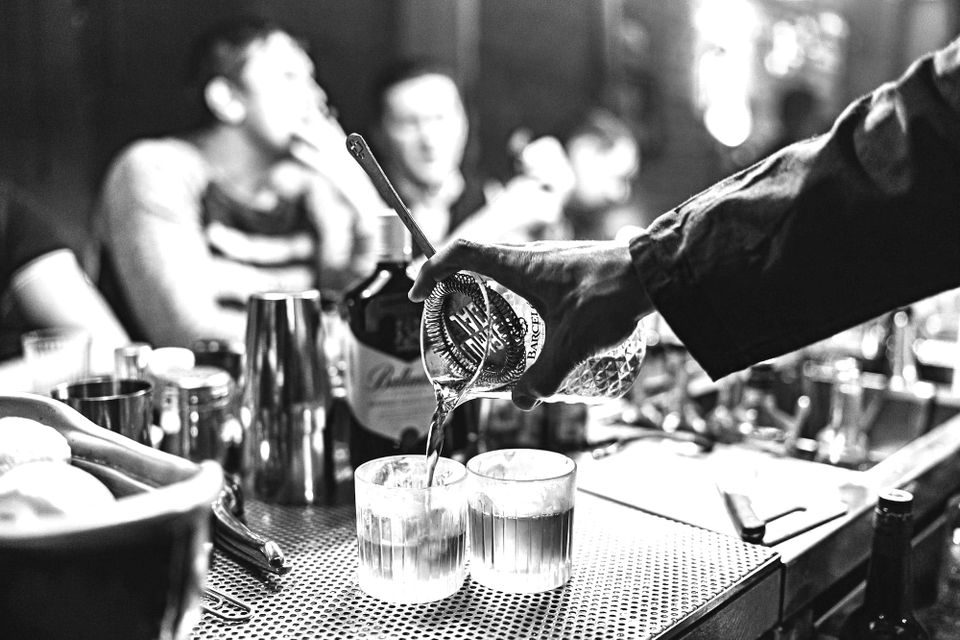
There is a moment during a Friday night rush when the bar reaches a particular density. Not chaos exactly, but a kind of sustained saturation where everything is happening at once and nothing can wait. Tickets are printing. Someone needs another round. A server is standing at the well with three checks. The couple at the far end have been ready to order for two minutes but the (good tipping) regular at the rail wants to talk about his favorite bourbon. Glasses are stacking up. The ice is getting low. And the person who has been studying the cocktail menu since she sat down chooses this exact moment to ask what I recommend.
I bartended for years in my youth, and I can tell you: this is not the part that breaks you.
What breaks you — what broke me, early on — is the belief that you need to somehow make it all slow down. That if you could just reduce the velocity of what is coming at you, you could handle it. So you try to go faster, or you stop to figure out what to do next, or you try to prioritize by thinking very hard about what matters most, and all three strategies produce roughly the same result: you fall further behind, and the service-well (what we used to call the hell-well) tickets keep printing and printing and printing, until they’re nearly touching the floor.
What changes, over time, is not speed. It is something harder to name.
An experienced bartender during that same rush does not look like someone going slowly. They may actually be moving faster than the novice. But something is different. Certain actions get grouped. Certain signals get noticed peripherally without requiring conscious evaluation. Routines that once demanded deliberation have become procedural. Physical space is organized so that fewer movements produce more results. And experience has built something that has nothing to do with speed — the ability to sense what is about to become a problem before it becomes one.
The novice experiences chaos. The experienced bartender experiences sequence.
Same bar. Same customers. Same fifteen minutes.
The environment did not slow down. What changed was the ability to differentiate what requires attention from what merely presents itself for attention — and to regulate the flow rather than simply react to it.
I think about this often, because the advice we give ourselves when the rest of life starts to feel like a Friday night rush is strangely different from what actually works behind a bar. We say: slow down. Unplug. Step away. Simplify. And those things have genuine value — for recovery, for reflection, for remembering what matters. No one should dismiss a quiet weekend or a walk without a phone.
But the next shift remains.
And when it arrives, the same field is waiting — the same density of inputs, the same competing demands, the same small rectangle through which everything announces itself and asks the same question: does this matter?
At first, it looks like a speed problem. Too much, too fast.
Look closer and it might appear to be a capacity problem — the system simply cannot handle the volume.
But underneath both is something else. A kitchen does not survive Saturday night service by telling everyone to slow down. That would be absurd. Nor does it solve the problem by simply adding more cooks — at some point, additional people actually make the kitchen less functional. What makes it work is mise en place. Stations. Sequencing. Expo. A division between what must happen now, what happens next, and what can wait. And someone regulating the whole — not cooking every dish, but maintaining enough awareness of the entire system to keep six stations from producing six individually correct components that collectively make a terrible dinner.
That is not a speed problem or a capacity problem. It is a regulation problem. And no amount of slowing down resolves a system that cannot distinguish what deserves to get through from what merely showed up.
This may be closer to what is actually happening when everything feels urgent but nothing feels important. Not that we are moving too fast — though we may be — but that the gates are open. Almost everything can announce itself. A notification, a headline, an email, a message, a calendar alert, a recommendation, a request, an update. Each one arrives through roughly the same channel and asks the nervous system the same question, over and over again: does this matter?
And without a way to regulate that question — without some way of sorting and sequencing what reaches us — the answer defaults to yes. Or worse, to a kind of exhausted maybe that never quite resolves.
You can put the phone away for the weekend. Walk in the woods. Read a book. Sit on the porch. Do absolutely nothing.
And perhaps you should.
But Saturday night will still arrive. And it may be even busier than Friday. The question is not whether you rested enough to withstand it. The question is whether, when everything begins asking for your attention again, you have any way of knowing what matters now, what comes next, and what can wait.
Loring Mortensen
Founder, The Eidetica Initiative