
We Don't Have an Information Problem
For most of human history, the great challenge of understanding the world was access. Information was scarce, expensive, and tightly controlled. Knowing things — about distant places, scientific discoveries, historical events, or even the weather tomorrow — required effort, proximity, or privilege. Libraries were treasures. Newspapers were lifelines. Encyclopedias took up entire shelves.
The assumption that grew out of this scarcity was simple: if people had more information, they would make better decisions, hold more accurate beliefs, and live more thoughtful lives. Knowledge was the bottleneck. Remove it, and clarity would follow.
That assumption has now been tested at a scale no previous era could have imagined. And the results are not what anyone expected.
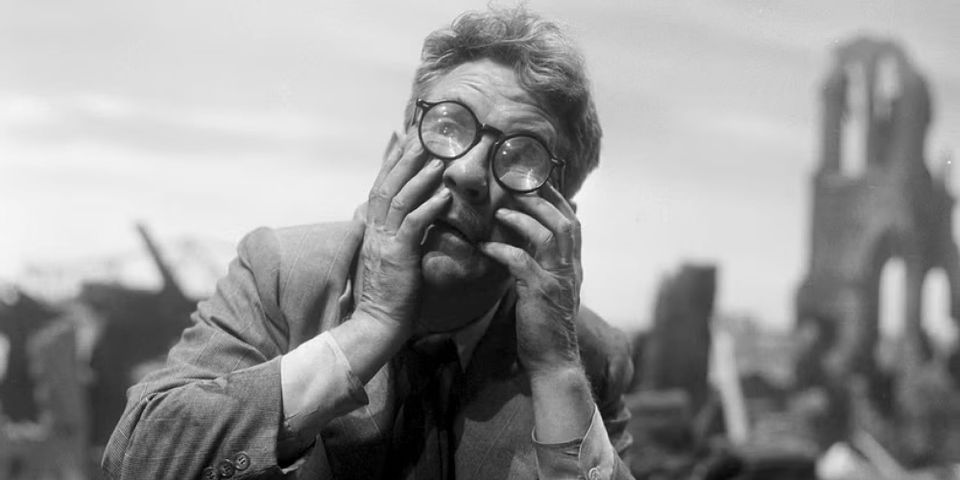
There is a famous Twilight Zone episode from 1959 in which Henry Bemis, played by Burgess Meredith, just wants time to read his books. The world denies him this in every way — until, by chance, he survives the end of civilization and finds himself surrounded by all the books he could ever want. He has finally arrived. He sits down to begin. And then his glasses break.
"That's not fair. That's not fair at all. There was time now. There was all the time I needed..."
— Henry Bemis, Twilight Zone, “Time Enough At Last”
Bemis had the books and lost the vision. We have the opposite problem. We have the vision — endless information, every claim accessible, every fact searchable — and we are losing the time required to actually see it.
We have removed the bottleneck. Information is now effectively infinite, instantly accessible, and constantly arriving. Every question can be researched. Every claim can be verified. Every event can be tracked in real time. By the standards of any prior generation, we are living in a knowledge utopia.
And yet.
People do not seem to be making better decisions. They do not seem to hold more accurate beliefs. They do not seem more thoughtful, more grounded, or more capable of distinguishing what matters from what does not. If anything, the opposite appears to be true. Confusion is widespread. Disagreement is sharper. Trust in institutions, in expertise, and even in shared reality has eroded in ways that would have seemed impossible thirty years ago.
The standard explanations for this are familiar: misinformation, algorithmic manipulation, polarization, bad actors, declining attention spans. Each of these explanations contains some truth. But they all share a common framing — they treat the problem as a corruption of the information environment rather than a feature of it.
I think the framing is wrong.
We do not have an information problem. We have an integration problem.
Information by itself does nothing. It is raw material. To become useful, it must be processed — placed in context, weighed against prior knowledge, tested for relevance, integrated into a coherent picture of how things work. That processing takes time. It takes attention. It takes the slow internal labor of fitting new things into the structure of what is already understood.
Integration is what produces clarity. Information alone produces only volume.
What has changed in the last several decades is not the quantity of information available. That growth was already underway in the print era. What has changed is the rate at which information arrives, and the speed at which the next signal interrupts the integration of the last one. We are not drowning because we cannot find the surface. We are drowning because we are not given enough time at any depth to actually breathe.
The result is a strange and historically unprecedented condition: people who know enormous amounts of disconnected facts, hold strong opinions about subjects they have never integrated, and feel certain about claims they have never had time to test. The information is real. The integration is missing.
This explains something that the standard framing cannot. It explains why more information does not seem to fix the problems caused by information. It explains why fact-checking, media literacy programs, and exposure to opposing views often fail to produce the expected effects. The bottleneck is no longer access. It is processing time. And processing time is the one resource that the modern information environment is structurally designed to take away.
The implications are uncomfortable. If the problem is integration rather than information, then the solution is not more or better data. It is the protection of the conditions under which understanding can actually form — interval, attention, repetition, time to sit with something before the next thing arrives.
That is not a popular framing. It does not scale. It does not optimize. It does not produce content.
But it may be closer to the truth than anything currently being offered. Though we may be too nearsighted to see it.
Loring Mortensen
Founder, The Eidetica Initiative