
The Difference Between Reacting and Deciding
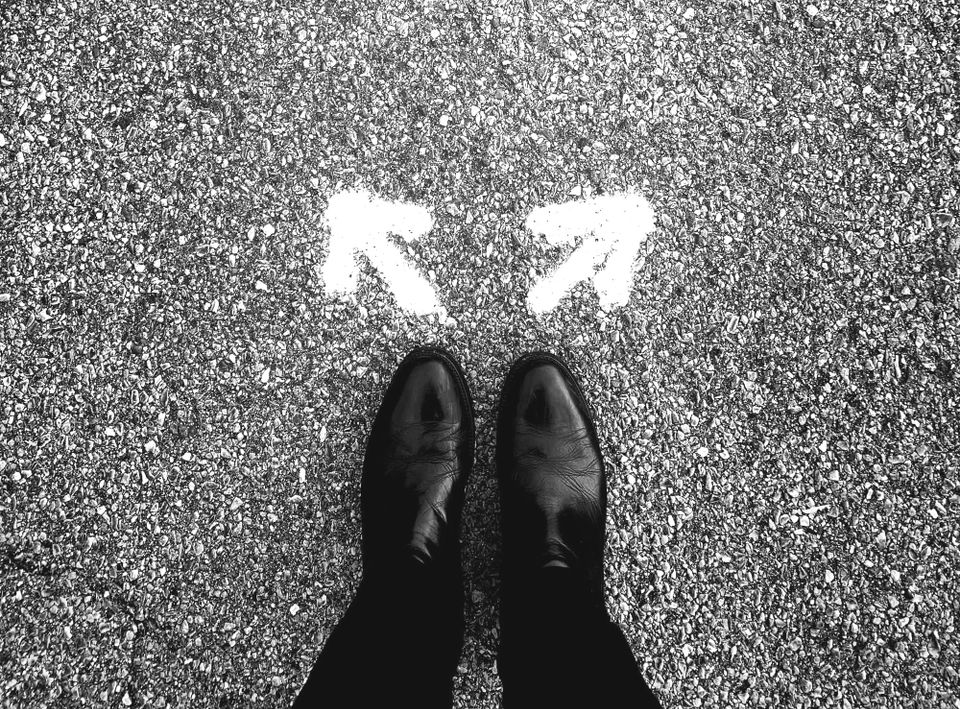
We tend to use the words "reaction" and "decision" as though they were close cousins — two different ways of arriving at the same destination. One faster, one slower. One instinctive, one deliberate. Both, in the end, producing action.
But they are not the same. And the difference matters more than we usually recognize.
A reaction is what happens when a stimulus arrives and a response follows without an interval between them. The body or the mind moves before anything has been weighed. There is no consideration of alternatives, no integration of context, no awareness of what is being excluded by the choice. Reactions are fast, often necessary, and sometimes the only thing that keeps us alive. A car swerves into your lane and you turn the wheel before you have time to think. That is reaction at its best.
A decision is something different. A decision occurs when a person holds open the possibility of multiple responses long enough to evaluate, even briefly, what each one might mean. The interval can be tiny — a fraction of a second is sometimes enough — but it has to exist. Without it, what looks like choosing is actually just responding.
Most of us assume we are deciding far more often than we actually are.
Consider a typical day. You check a message and reply. You see a notification and tap it. You scan an email and click a link. You hear a question and answer it. Each of these feels like a decision because it involves your participation, but in many cases the interval that would distinguish reaction from decision has already collapsed. The response arrives before you have time to ask whether it should.
This is not a moral failure. It is a structural one.
The environments we operate within are designed to shorten that interval. Every interface, every notification, every prompt is optimized to compress the distance between perception and response. The faster you act, the more "engaged" the system considers you. The faster you act, the less you decide.
What is lost in the compression is not just thoughtfulness. It is something more fundamental: the ability to know what you actually want before you respond to what is in front of you.
A person who is mostly reacting can still appear competent. They answer messages, complete tasks, manage crises, and check boxes. They look effective from the outside. But over time, something accumulates that has no name in the productivity literature: a quiet sense that their life is happening to them rather than through them. They are responsive without being directional. They are busy without being committed. They feel, increasingly, like a function of their environment rather than an author of it.
This is what reaction without decision produces. Not failure, but drift.
The distinction matters because the remedy is not what most people assume. The answer is not to react faster, or to react better, or even to react less. The answer is to recover the interval—to rebuild the small space between perception and response in which actual decision becomes possible.
That space is often uncomfortable.
When a stimulus arrives and no immediate response follows, a kind of tension appears. Something in us wants to resolve it quickly—to answer, to act, to move forward, if only to relieve the pressure of not knowing. In many cases, what we call a “decision” is simply the fastest available way to end that discomfort.
But the interval is not a problem to eliminate. It is the condition that makes decision possible.
The people who make the most effective decisions are not the ones who move the fastest. They are the ones who can remain in that space just long enough to allow alternatives to become visible—to let context form, to sense what is at stake, to recognize what each response might commit them to.
“…the most creative professionals always played with the problem for much longer before they tried to resolve it. Because they were prepared to tolerate that slight discomfort and anxiety that we all experience when we haven’t solved a problem. You know what I mean, if we have a problem, and we need to solve it, until we do we feel inside that there’s this kind of internal agitation or tension or uncertainty that makes us just plain uncomfortable. And we want to get rid of that discomfort. So in order to do so we take a decision. Not because we’re sure it’s the best decision, but because taking it will make us feel better. Well, the most creative people have learned to tolerate that discomfort for much longer, and so just because they put in more pondering time their solutions are more creative.”
— John Cleese
The interval does not need to be large. A fraction of a second is often enough. But it has to exist.
Because without it, there is no distinction between what is happening to you and what you are choosing.
A second of pause before responding is not a luxury. It is the difference between living and being lived.
Loring Mortensen
Founder, The Eidetica Initiative