
Why Everything Feels Urgent But Nothing Feels Important
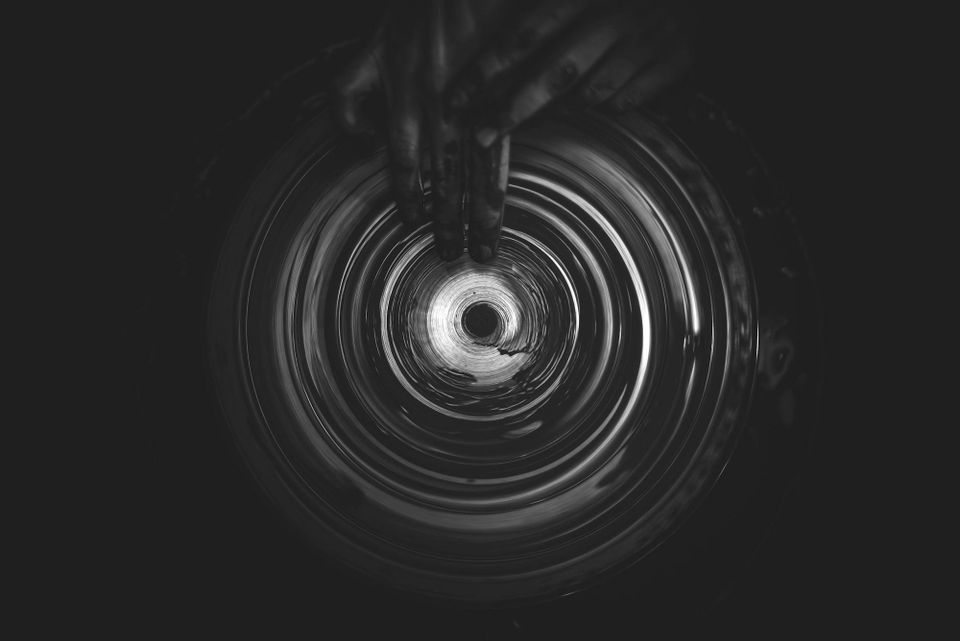
by Loring Mortensen
There is a particular kind of exhaustion that has no name yet.
It is not the exhaustion of hard labor or long hours, nor is it grief, though it sometimes resembles it. It is the feeling of having responded to everything and attended to nothing—of ending a day knowing you were busy the entire time, but unable to point to a single moment where something actually mattered.
Most people recognize this immediately. They nod before you finish describing it.
It reminds me of Douglas Adams and John Lloyd’s The Meaning of Liff, a book built around the idea that many common human experiences go unnamed. Their solution was simple: assign names to them—sometimes humorously, sometimes uncomfortably accurately. We do not yet have a word for this kind of exhaustion, but we are getting close to recognizing it.
Adams offers another useful lens. In The Restaurant at the End of the Universe, he imagines the “Total Perspective Vortex,” a device that shows a person the entire scale of existence—and their exact place within it. It is described as the most devastating experience possible, because it gives the one thing no living mind can sustain: a complete sense of proportion.
We have built something functionally similar—not a machine, but an environment.
The exhaustion many people feel today is not the result of too much information, too many notifications, or a lack of discipline. Those explanations share a common assumption: that the problem is behavioral, and that if we managed ourselves better, the feeling would resolve.
But the deeper shift is structural.
The environment in which we make decisions has changed faster than our capacity to process it. Not just in volume, but in velocity—in the rate at which information demands response. Every input now arrives with an implicit instruction: respond now. Not because it matters, but because the systems that deliver it are optimized for immediacy. Messages, feeds, alerts, and updates are all designed to shorten the distance between reception and action.
And so we comply. We respond, we react, we clear the queue—but something is lost in the clearing.
When every signal is treated as immediate, the ability to distinguish what matters from what is merely present begins to erode. Urgency is no longer occasional; it becomes ambient. It is not a spike against a calm background—it is the background itself. And against that constant pressure, importance has no way to register.
This is not a failure of attention. It is a failure of differentiation.
Differentiation requires something that acceleration systematically removes: time between perception and response. A mind that can distinguish between what is happening now, what led to this moment, and what will matter next is a mind that can prioritize. But without that interval, everything collapses into the present. The past becomes inaccessible, the future becomes difficult to imagine, and the present fills with competing signals—each one demanding action, none of them offering meaning.
This is where the exhaustion comes from: not from effort, but from the absence of coherence.
In Adams’ story, one character survives the Vortex—not because he is especially resilient, but because the version he experiences is artificially constructed, a universe designed entirely around him. In that context, the machine tells him he is the most important thing in existence, and the experience becomes tolerable.
“For when you are put into the Vortex you are given just one momentary glimpse of the entire unimaginable infinity of creation, and somewhere in it a tiny little marker, a microscopic dot on a microscopic dot, which says "You are here.”
― Douglas Adams, The Restaurant at the End of the Universe
We do not live in that kind of universe.
The question worth sitting with is not how to manage time more efficiently, or how to respond more quickly. It is something more unsettling: what happens to a mind—or a society—when the space required to distinguish urgency from importance is no longer available?
That question does not have a quick answer, which may be exactly the point.